rage bait.
Content designed to provoke anger so people will react, argue, share, or keep watching.
The joke.
Then the context.
The group chat said rage bait. My brain said help.
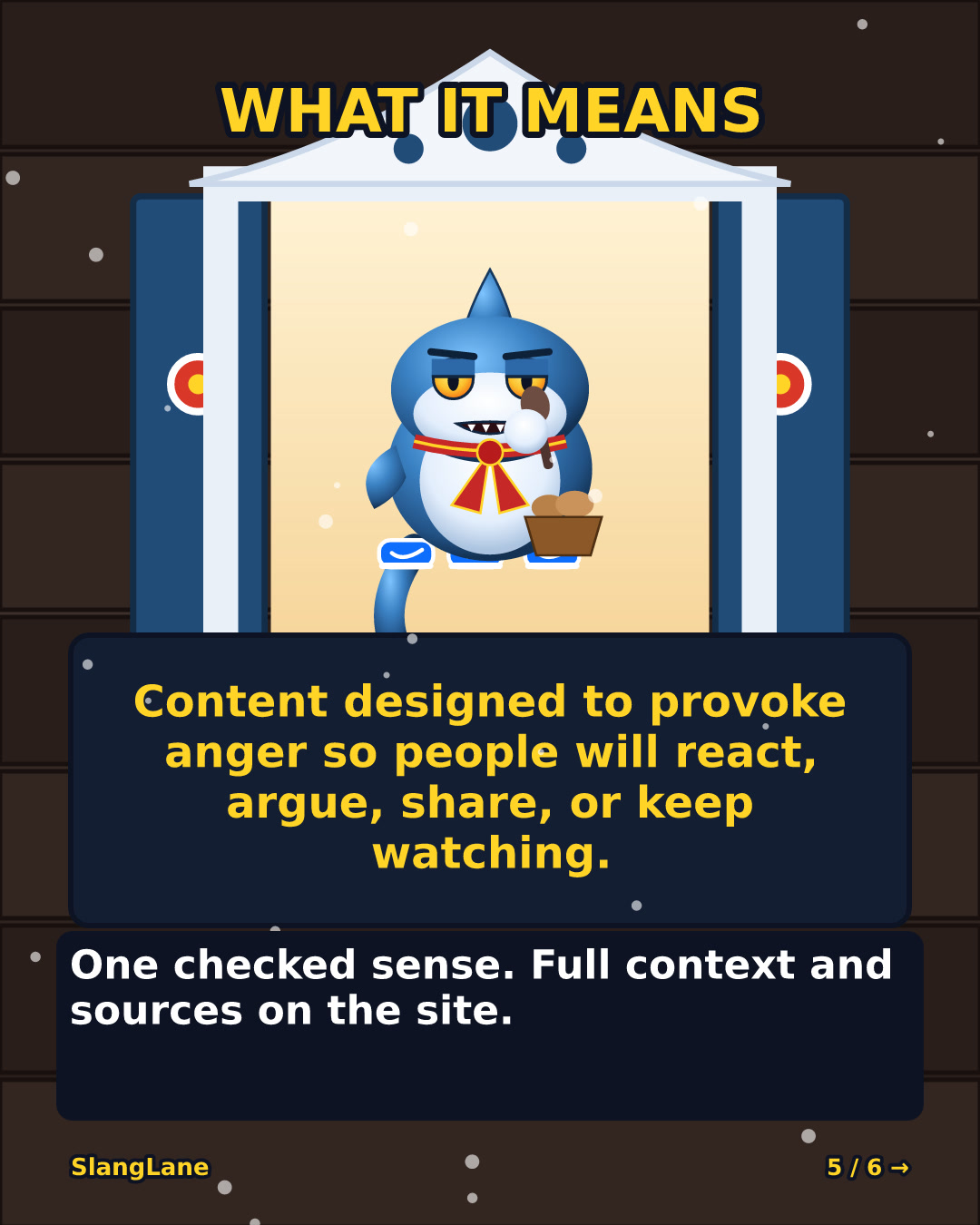
Content designed to provoke anger so people will react, argue, share, or keep watching.
Swipe the carousel · 6 slides



Original fictional sketch · synthetic voices · meaning from this published entry.
What does rage bait mean?
Rage bait uses outrage as an attention hook. A deliberately provocative opinion, an obviously frustrating demonstration, or a misleadingly framed clip may invite people to correct or condemn it. Those reactions can be exactly what the creator wanted.
The term implies a strategy, not simply a result. A sincere disagreement can make people angry without being rage bait. If intent is unclear, “this seems designed to provoke” is more careful than claiming you know why someone posted it. The label can itself become a way of dismissing criticism, so look at the actual content and context.
How does “rage bait” sound when someone sends it to you?
Tap a reaction above to compare your reading with other visitors, or test a full message below:
See how it lands.
Original examples written for this entry, not quotations from the sources.
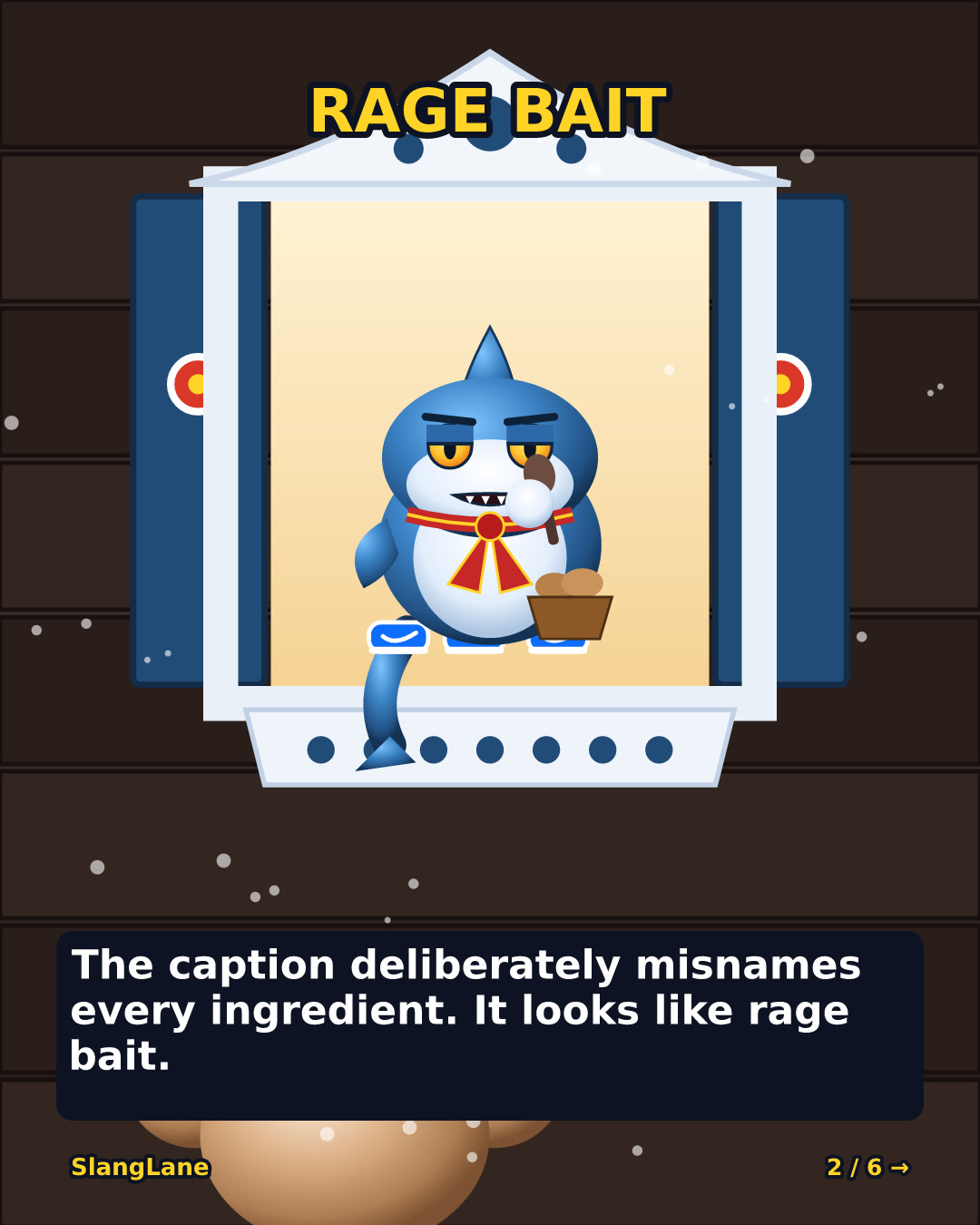
The caption deliberately misnames every ingredient. It looks like rage bait.
I nearly wrote an essay in the replies, then realized I was feeding the rage bait.
The right word.
The right moment.
Use it when discussing a plausible outrage-driven engagement tactic, and explain the feature that makes you suspect deliberate provocation.
Do not label every unpopular opinion or genuine complaint as rage bait. Causing anger is not by itself proof of a calculated tactic.
Not quite the same as…
clickbait
Clickbait seeks clicks through a headline or framing. Rage bait specifically seeks an angry response, with or without a link.
A little backstory.
The compound combines rage with bait. Oxford chose rage bait as its 2025 Word of the Year; that documents prominence, not a claim that it began in 2025.
Supported by Oxford University Press
Still wondering?
Is rage bait always false?
No. It can use truthful material framed provocatively. The alleged goal is the angry engagement.
How is it different from an offensive opinion?
Rage bait implies a deliberate attention strategy. An offensive opinion may be sincerely held; intent needs evidence.
Sources & checks
Meaning and factual notes are informed by the references below. Examples and usage advice are original editorial writing. A source documents use; it does not measure current popularity.
- ragebait — English entry ↗Wiktionary contributors · checked 19 Oct 2026Supports: meaning; usage
- The Oxford Word of the Year 2025 is rage bait ↗Oxford University Press · checked 19 Oct 2026Supports: meaning; 2025 selection
When should you avoid saying “rage bait”?
Do not label every unpopular opinion or genuine complaint as rage bait. Causing anger is not by itself proof of a calculated tactic.
Informal register (Critical · media language); acceptable in casual team chats, though standard prose is preferred in external documentation.
Generally safe in playful banter and voice notes when matched to the other person’s texting style.
Register: Critical · media language. Do not label every unpopular opinion or genuine complaint as rage bait. Causing anger is not by itself proof of a calculated tactic. Over-explaining “rage bait” or putting it in quotation marks immediately signals out-of-group / Millennial-or-Boomer register switching.
Used primarily across Online English; tone relies heavily on surrounding punctuation and thread velocity.
Casual text without period (“rage bait”): 18% tension · Clipped reply with a trailing period (“rage bait.”): 66% passive-aggressive signal. Read full tone & subtext guide ↗
How “rage bait” changes meaning by context & how to reply
Classic dictionaries list a definition; real conversations depend on register switching. Use this 3-column pragmatic matrix to decode the subtext and reply without sounding dry:
| Context & Message | Hidden Pragmatic Subtext | How to Reply (Copy-Ready) |
|---|---|---|
Casual Group Chat / Banter“The caption deliberately misnames every ingredient. It looks like rage bait.” |
It may be trying to attract angry corrections. (Critical · media language, sincere or playfully exaggerated) | “No cap, that’s 100% valid — let’s lock it in 🫡” Register: Match energy (Casual / Warm) |
Short / Potentially Dry Text (With a Period)“rage bait.” |
Abrupt punctuation strips warmth; may signal low energy, mild annoyance, or sarcastic compliance. | “Wait — good “rage bait” or stressed “rage bait”? Just checking the vibe.” Register: Disarming & Clarifying |
Dating App / Early Texting Thread“I nearly wrote an essay in the replies, then realized I was feeding the rage bait.” |
My angry response would have rewarded the provocation. | “Careful, that sounds dangerously close to a side quest I’d actually say yes to.” Register: Playful / Non-Dry Banter |
Workplace Slack / Client Translation“The caption deliberately misnames every ingredient. It looks like rage bait.” |
Needs code-switching into professional register before forwarding to stakeholders. | “It may be trying to attract angry corrections.” Register: 100% HR-Safe Standard English |
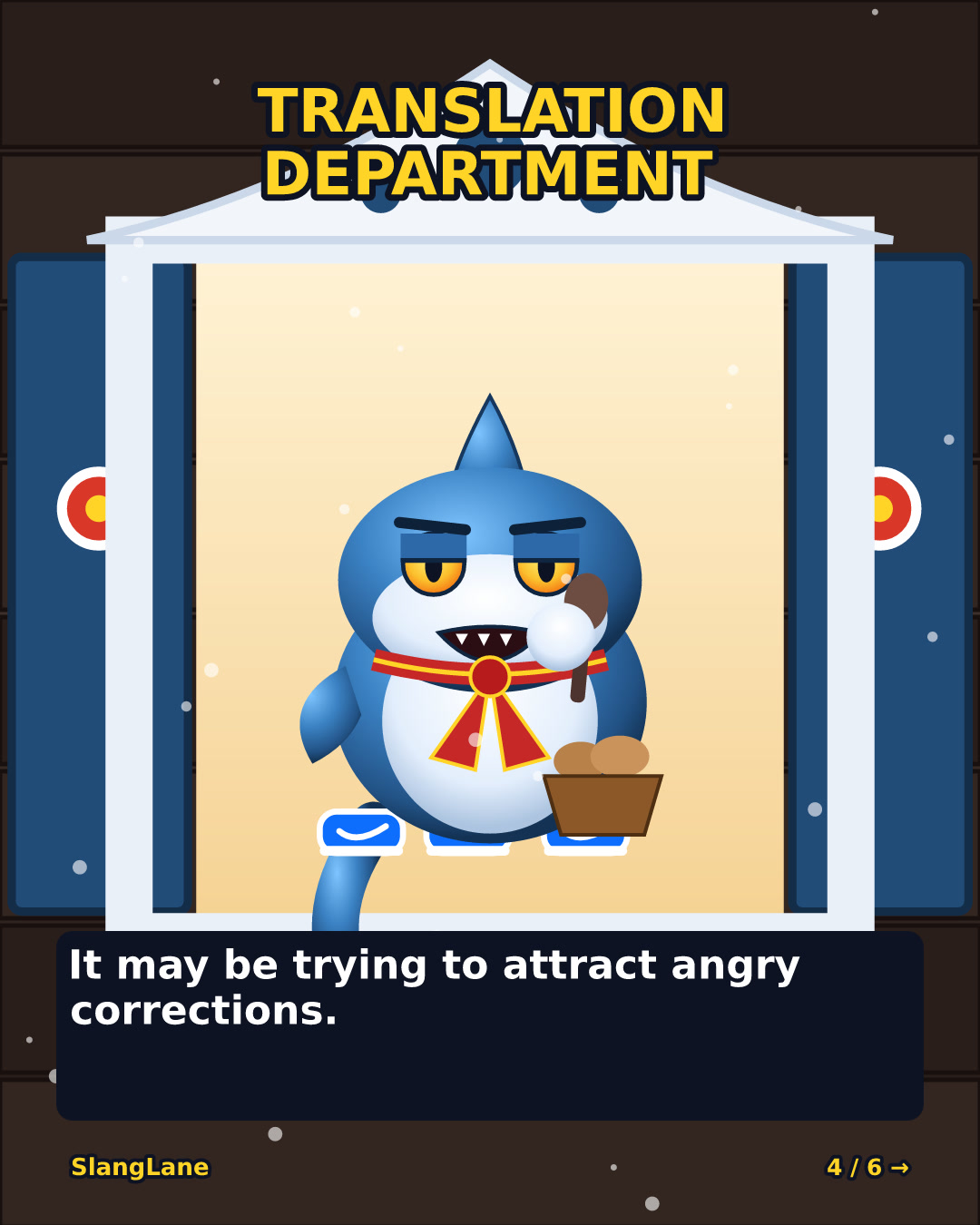
“It may be trying to attract angry corrections.”
“Honestly, it may be trying to attract angry corrections. — proper sorted, no drama.”
Is “rage bait” safe for school or work — and how do you reply?
General-audience informal vocabulary (SFW): “rage bait” is a general-audience expression (Critical · media language) included in our 100% SFW ESL Classroom Kit. It fits casual group chats and informal conversation, but should be translated into standard English in formal client or academic writing (translate with the Corporate ↔ Gen Z tool ↗).
How to reply when someone uses “rage bait” in a chat: Match the speaker’s register (Critical · media language). If they are joking or exaggerating, a brief acknowledgment (such as bet, no cap, or grand) fits; if the message is in a professional channel, reply in plain English: “It may be trying to attract angry corrections.”.
Embed “rage bait” on your site, blog, or course
Copy this one-line snippet to embed a live SlangLane definition card for rage bait (or stamp a Court / HR Exhibit card ↗):
<script src="https://slanglane.com/embed/rage-bait.js" async></script>
Iframe version for Moodle / Canvas / Notion: <iframe src="https://slanglane.com/embed/rage-bait" width="100%" height="200" style="border:0;max-width:480px" loading="lazy"></iframe>
Compare usage: rage bait vs. clickbait ↗ · rage bait vs. ratio ↗ · rage bait vs. doomscrolling ↗
Academic & press citation
SlangLane Editorial & Linguistics Lab. (2026). “rage bait” — SlangLane Open Reference Corpus (Release daily-2026-11-20). CERN Zenodo. https://doi.org/10.5281/zenodo.23541347 · Canonical URL: https://slanglane.com/terms/rage-bait · All PDF working papers ↗